Introduction
Reading about a method of house division is more or less the same as playing telephone tag (or broken telephone), game in which messages are whispered from person to person for the original and final messages to be compared thereafter. Most authors have incurred descriptive errors, but no description has had the greatest amount of errors than Placidus, the method of house division popularised (not necessarily developed) by the Benedictine monk Placidus of Titis (1603-1668), inspired by Giovanni Antonio Magini’s firs tables (1604) and Ptolemy (primary directions by diurnal arcs or semiarcs). It is the same method as primary directions (natural/diurnal motion) with two different applications: while the one regards prognoses, the other horoscope measurement or construction. Brilliant English practitioner and talented drummer Michael Wackford argued (2006): “Unfortunately, the standard definitions of the house system that bears Placidus name have often been repeated incomprehensibly (or wrongly), and some authors, in misleading themselves as well as their readers, have caused several corrupt variations to gain currency.”
However, even Michael could not offer a sufficiently clear explanation of the mechanism for the readers in the article wherein he wrote the above (although he did not provide a “corrupt” description in any way whatsoever either, and understood Placidus well). This is why we would like to provide more clarity with as little technicality as possible.
The Key
Just as each segment of the ecliptic (i.e. sign) has a specific time of oblique ascension at a specific latitude (the same as the sun would have had at the same latitude when it occupied that sign or segment), so does each of its degrees (the same as the sun would have had at the same latitude when it occupied that degree) in its journey from the horizon (Asc) to the midheaven (MC) and from here to the opposite point of the horizon (Des).
If you were to look up the key word «proper time» in a dictionary of Physics or Google, you will learn that the path of an object is that which it takes pursuant to its own clock. Proper time, then, is just an analogy, but does draw a conceptual parallel.
Hence Anthony Louis (2022) note: “[…] In other words, the astrological houses of a natal chart must necessarily divide the spacetime around us at the moment of birth”. And adds: “The Placidus system is consistent with Ptolemy’s description […] which takes into account both space and time [simultaneously], anticipating Einstein’s notions of space-time and the non-Euclidean geometries of the 19th century, implicit in Ptolemy’s original writings […]”
The Key’s Cause
Both rotation (day) and revolution (year) can be considered two inertial frames of reference as long as we remain at the same latitude and the same longitude, for the different times of oblique ascension will remain the same for all signs or segments (i.e. months) and degrees (i.e. days). As Galileo would have suggested, all inertial frames of reference were created equal.
The tilt of a non-inertial or moving frame of reference (Earth) relative to an inertial frame of reference (ecliptic) is responsible for the first form of (classical) relativity known to us, tropical astronomy, in addition to another two (special relativity, or velocity, and general relativity, or gravity). Put simply: each day (i.e in or at each degree) the sun has a slightly different ascensional time than the previous day and the day that follows.
The differences of the lengths of time become greater as greater the angular distance or longitude between the segments of the ecliptic (e.g. between July and January, instead of between July 20 and August 21 or between July 20 and July 21) and that of the observer from the equator. From this follows that the amount of time spent by a sign or an ecliptic degree in rising above the horizon in the Caribbean varies relative to both the observer in New York or in Kodiak and to each day or month (i.e. each degree or sign, respectively) at the same latitude, for in both cases they conduct their observations from different frames of reference.
The Key’s Implications
Because the amount of time that the sun would have invested in travelling from the ASC to the MC would be different in accordance with both the location of the observer and the month of the year, all oblique ascensional times of all twelve segments of the ecliptic and their individual degrees mirror the behaviour of the Sun when it occupied them. Each degree will always preserve or retain the ascensional time of the sun. Also, the same properties: a) element (type of wavelength or solar influence), b) polarity (electric charge), and c) modality (intensity or consistency).
The unequal rates of primary motion at each latitude, which contract and expand the volumes we know as houses, constitute the basis of cuspal discernment (all methods of coordinate transformation or house division honour this phenomenon with regard to the four angular cusps, while adhering to a foreign frame of reference, the prime vertical or the celestial equator, concerning nonangular cusps, forgetting these other frames served as footholds only when logarithms were not yet made available by Napier in 1614).
The twelfth or eleventh cusp (or that the exact region of the horizon occupied by the degree in question) represents a different ascensional time (a different trisection, therefore) than that of the ASC (Alcabitius) and that of the MC (Koch). Our sky is flooded with imaginary diurnal lines and it is our task to discern the point of intersection between these and the zodiacal belt (i.e. ecliptic).
Although somewhat relativistic, it is very simple.
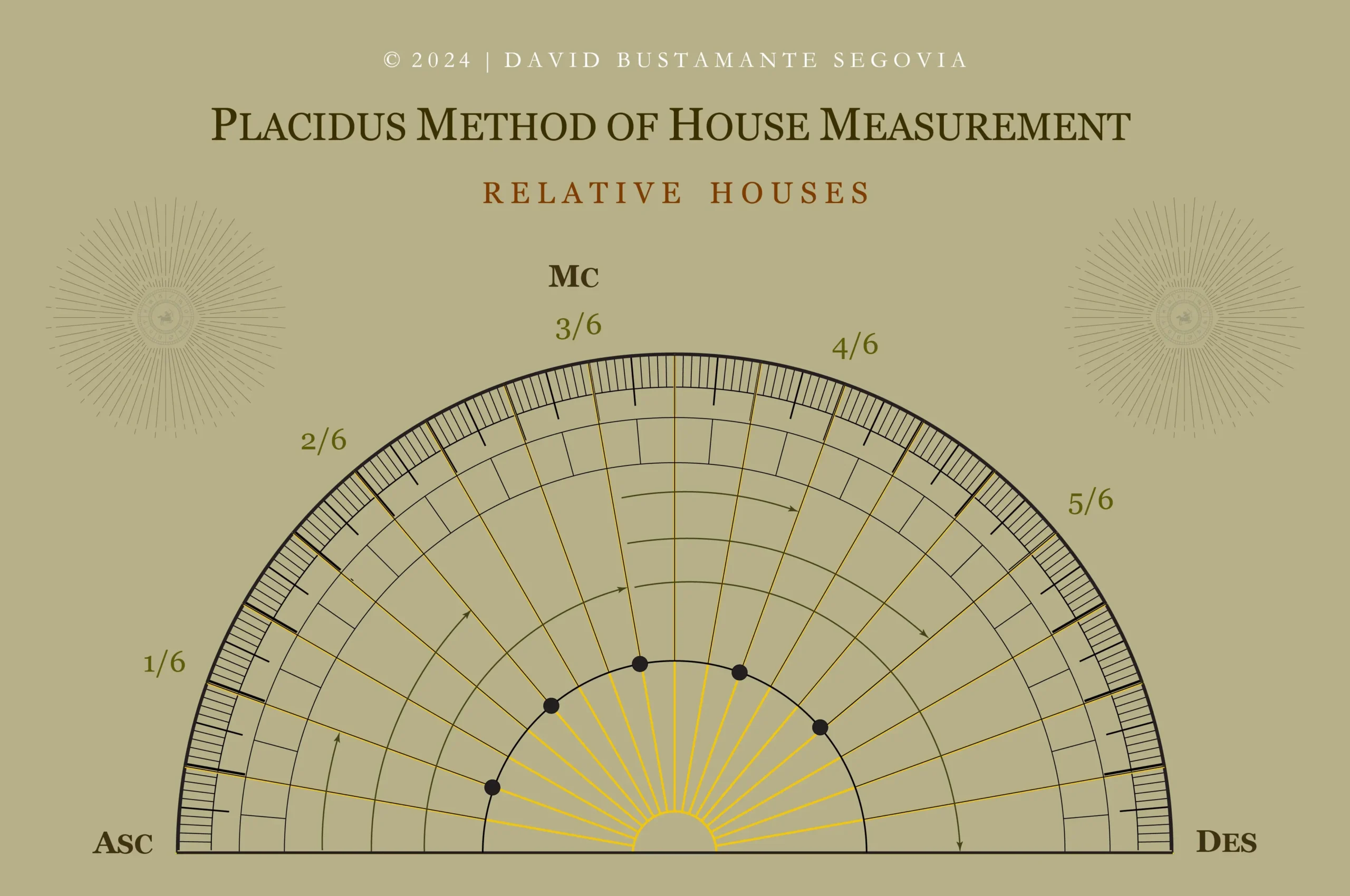
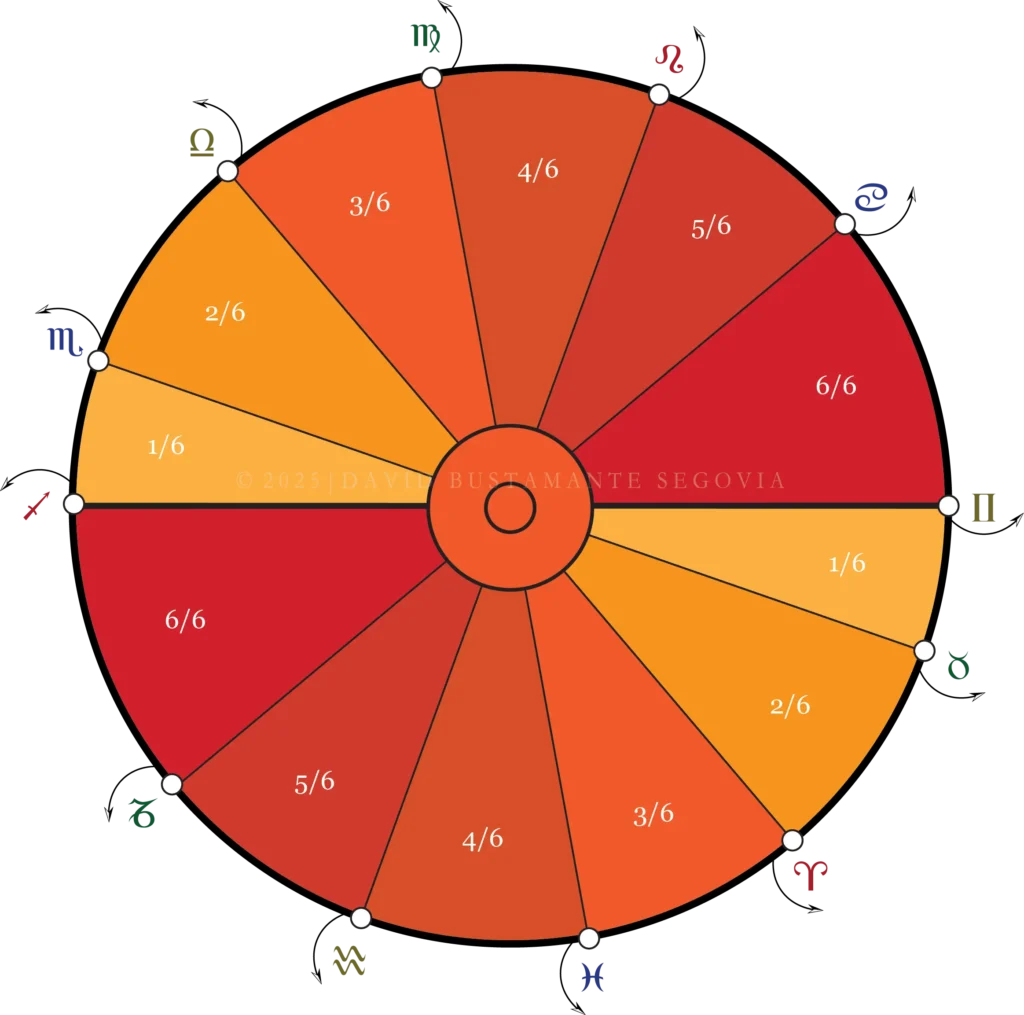
Each sixth of the diurnal arc represents the path travelled by a different zodiacal degree, which bears its own time of ascension or apparent angular speed. Therefore, each length of time constitutes one, two, three, four, or five sixths of the time that would have elapsed since the sun’s rise if it had occupied that degree of the ecliptic (i.e. all five cuspal degrees constitute five distinct trisections). We thus measure the time of all simultaneously and uninterruptedly in order to determine the house cusps as accurately as possible. Such measurement, however, is not trigonometric, but physical, so that it may continue to perform accurately in polar regions.
Seasonal or Planetary Hours
You are then able to establish the seasonal hours of whatever degree of the ecliptic you choose, meaning each—seasonal—hour will constitute one twelfth of the total amount of time that the sun would have spent in the visible (diurnal hours) or invisible (nocturnal hours) sky if it had occupied that degree. Therefore, any cuspal degree will necessarily appear in the next cusp every two seasonal hours of said degree. Let this be the only proportional feature of the Placidus measurement, for each house will measure a different length of time.
House Systems: An Intrinsically Unnecessary Debate
Most professionals, otherwise competent, have not understood the mechanism of action of this coordinate system, and the vast majority focus only upon repeating what they read in historical documents or textbooks, namely, that Placidus trisects or divides the semiarc into three parts equally on the basis of time. But so does Alcabitius and Koch, and it would seem that they have found some difficulty in explaining the difference. Both Alcabitius and Koch conduct a timekeeping or Placidus measurement for a single degree of the ecliptic, while Placidus for all simultaneously (explained above).
Can it be said that, should the community have understood this from the beginning, Placidus would have become the sole method considered valid? Ironically, this (organic or natural) method of cuspal ascertainment precedes the rest, for it stems from Ptolemy’s Tetrabiblos.
______________
References
Carroll, Sean. (2022). The Biggest Ideas in the Universe. Space, Time, and Motion. Dutton. Penguin Publishing Group. New York.
Chatham, Rhys. (Abril 2, 2021). “Placidus versus Alcabitius House System.” Rhys Redmond Chatham Astrology. Retrieved from: https://rhysastrology.fr/placidus-vs-alcabitius/
Forest, Steven. (2023). “Why I Use Placidus Houses.” Forest Astrology. Retrieved from: https://www.forrestastrology.com/blogs/astrology/why-i-use-placidus-houses
Holden, Ralph. (repr. 2023). The Elements of House Division. Raven Dreams Press. Boulder, Colorado, USA.
Louis, Anthony. (December 28, 2022). “Space-Time and Astrological House Systems.” Anthony Louis Astrology Blog. Retrieved from: https://tonylouis.wordpress.com/2022/12/28/space-time-and-astrological-house-systems/
Louis, Anthony. (February 23, 2023). “William Lilly’s Squares [λ 90º] acting like Sextiles [λ 60º]!” Anthony Louis Astrology Blog. Retrieved from: https://tonylouis.wordpress.com/2023/02/23/william-lillys-squares-acting-like-sextiles/
Louis, Anthony. (September 5, 2024). “Can a sextile [60º] act like a square [90º]?” Anthony Louis Astrology Blog. Retrieved from: https://tonylouis.wordpress.com/2024/09/05/can-a-sexile-act-like-a-square/
Placidus de Titis. (1814) Primum Mobile. trans. John Cooper. David and Dickson. London, England, UK.
Ptolemy. (1940). Tetrabiblos. Loeb Classical Library. Harvard University Press. Boston, Massachussets. USA
Wackford, Michael. (1994, repr. 2006). “Placido and the semi-arc method of house division.” Skyscript. Retrieved from: https://www.skyscript.co.uk/placido.html